Ever notice how every catalog for power-management devices has about a gazillion items? There are buck, boost, buck-boost, multi-phase regulators, load switches, LDOs, battery chargers, multi-phase controllers, sequencers, supervisors – and every one of those is available in about fifty different sizes, shapes, voltages, currents, tolerances, and packages. Of course, then, when you try to find exactly the right one for your design – they don’t have what you need. You end up settling for a little too much of this and a little too little of that for more BOM cost than you originally intended to spend.
Then, there is your PCB. Your board has all the major components, of course – your processors, FPGAs, memories, and interfaces. And spider-webbed between all that are what seem like acres of different PMICs and caps and other passive components providing life support to the big stuff. Each and every one of those is usually a different part number with a different set of compromises built in.
This week, startup company AnDAPT announced a new line of programmable power chips that lets you have exactly the multi-rail power management device you need – with no compromises. You choose the configuration that specifies precisely what your design requires, and you get a chip that does exactly that. Are you picturing a fab full of PMIC elves, toiling away day and night to make special power parts just for you? Well, it’s kinda like that, actually.
Radical innovation is rare in the power management market, as technology there seems to move at a much slower pace than in the digital world. Not that today’s analog devices aren’t innovative – they certainly are – but the frequency of discontinuous change is low. Most of us have been using the same kinds of bucks, regulators, and so forth for years if not decades with little change. AnDAPT’s technology, though, may just be one of those rare radical changes.
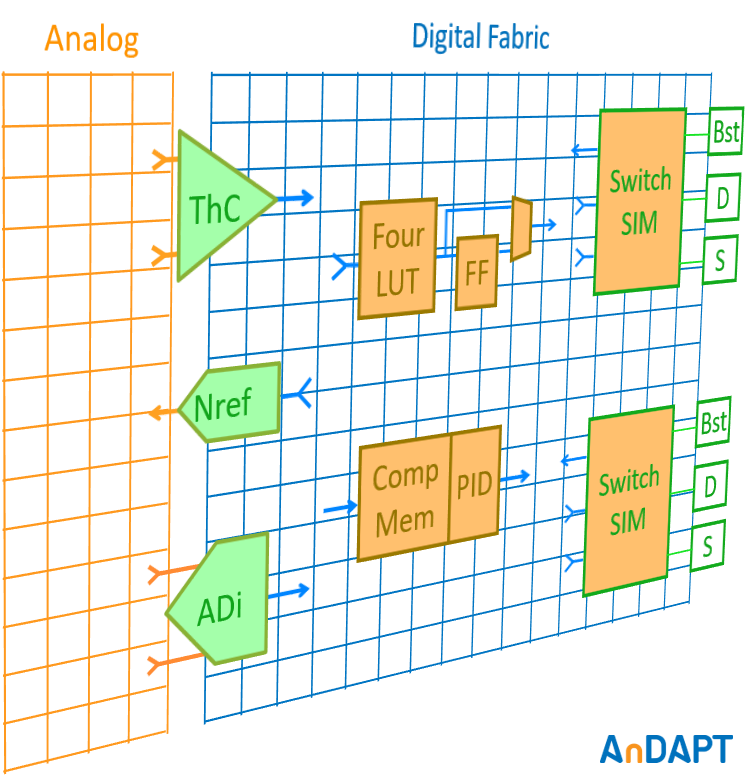
The AmP™ Adaptive Multi-Rail Power Platform family is a new technology developed by AnDAPT. It’s called a “Platform” because each device can be customized to perform a wide variety of power-management-related functions. How does this work? OK, don’t panic, but deep inside, the silicon actually has a direct relationship to FPGAs. (Really, don’t panic. You’ll probably never notice.) Devices are made up of several types of blocks, including “power blocks” with scalable integrated MOSFETS (SIM) that include integrated current sense for protection and current share. Power Blocks are used to build power path topologies.”Sensor blocks” have integrated adaptive digitizers, comparators, summation amplifiers, and noise-Immune references. Sensor blocks are used to sense and manage analog voltage and current.
These blocks are stitched together with programmable digital and analog fabric (that’s the FPGA-like part) which interconnects the µAnalog, µLogic, precision timers, and compensator RAMs. The device can provide telemetry via built-in PMBus over I2C. SPI can be used for device configuration.
The AmP family consists of nine members with three selections, four, eight and twelve power blocks of 1A, 3A, and 6A current capacity each. These nine chunks of silicon are capable of implementing an enormous variety of PMICs, which is the magic of the whole AmP platform. And there is a reason that the whole AnDAPT story may sound familiar to FPGA folks. The company was founded by President and CEO Kapil Shankar, who many will remember from FPGA company SiliconBlue (which was acquired by Lattice Semiconductor a few years ago). Kapil has brought his expertise in programmable devices into the analog/power world, to solve problems that he encountered when he was working with system designers in the consumer, mobile, and industrial markets.
So, if these devices are “configurable” like FPGAs, how does one go about configuring them? AnDAPT offers an easy-to-use set of tools that customize their devices for your application. WebAmP is a licensable, cloud-based power design tool which is available complete with a power analysis tool suite. Also available is an AmPLink Adapter, which connects to a USB port to download a bit stream to personalize an AmP device as a user-designed On-Demand power management unit. AnDAPT has a number of applications already designed, and creating or customizing is generally a matter of a few drag-and-drop steps in a simple interface.
AnDAPT has also already created a number of ready-to-use applications of their devices, and they create custom configurations for customers as well, often including the same kind of testing one would need and expect on an off-the-shelf PMIC. One beauty of the AmP solution that may not be apparent at first is the simplification of your BOM and procurement process. By consolidating what often would be a grab bag of different PMIC devices into one platform, your manufacturing flow may be improved as well as your design.
According to the press release, “The product family is offered in QFN packages with 6×6, 7×7, 8×8 footprint sizes. Initial device AmP8DS6QF74 is available today, in a 74-pin, 8-mm- by-8- mm-by- 0.85-mm thermally enhanced QFN package. The lowest cost member of the family AmP8DP1QN52 is priced at US $3.75 in 1,000-unit quantities. WebAmP tools and power components can be licensed today online and are available for a 30-day free trial period.”


Leave a Reply
You must be logged in to post a comment.