As part of giving courses on digital logic simulation, along with presentations at technical conferences and guest lectures at universities, I’ve been fortunate enough to have at least sampled a tempting taster of many of the countries in Scandinavia and Western Europe, including Denmark, Norway, Sweden, France, Greece, Germany, Italy, the Netherlands, and Switzerland.
Sad to relate, one of the countries on my “bucket list” that I’ve yet to see is Spain, and one of the cities in Spain I’ve long wished to visit is Barcelona. Several of my English friends have holidayed in Barcelona, and I know some Spanish embedded engineers who hail from that fair city. I’ve heard so many tales about the awesome food scene, including evenings spent in tapas bars munching on plate after plate of the most delightful nibbles, that I’m drooling as I pen these words.
The origins of Barcelona are shrouded in mystery. The ruins of an early settlement, including tombs and dwellings, have been found dating to around 5000 BC. Some sources suggest that Barcelona may have been named after the Carthaginian general Hamilcar Barca, who was supposed to have founded the city in the 3rd century BC, but there is little solid evidence for this. What’s known for sure is that the Romans repurposed whatever was already there as a military encampment and colony called Barcino circa 15 BC, which means the city has remained in the same place for over 2,000 years. Today, of course, Barcelona has evolved into a major cultural, economic, and financial center in southwestern Europe, a transport hub (air, sea, road, and rail), as well as the main biotech hub in Spain.
Even though I’ve not, thus far, been fortunate enough to visit Barcelona, this video featuring the song La Rumba de Barcelona by French-Spanish singer Manu Chao makes me feel as though I already know the metropolis.
Quite apart from anything else, Barcelona is home to the Mobile World Congress, an annual trade show that’s billed as being the largest and most influential connectivity event in the world. The most recent MWC, which was held from February 27 to March 2, 2023, attracted 2,400+ exhibitors and 88,500+ attendees from 202 countries and territories.
Speaking of FPGAs (we weren’t, but we are now), I remember when these little scamps first appeared on the scene. Prior to the arrival of FPGAs, circa the early-1980s, I was working with programmable logic devices (PLDs) like programmable read-only memories (PROMs). We used these devices for a wide variety of tasks, including gathering glue logic together, implementing look-up tables, realizing finite state machines (FSMs), and effecting last minute changes to fix anything we’d messed up in the main design.
As I recall, Xilinx announced the first FPGA, the XC2064, in 1984 and delivered it in 1985. The XC2064 boasted an 8 x 8 array of configurable logic block (CLB) “islands,” each containing two 3-input look-up tables (LUTs), all floating in a “sea” of programmable interconnect. Unfortunately, there were no sophisticated design tools for these devices; you were obliged to define the contents of each LUT by hand, and you had to specify how the interconnect was to be configured by hand also.
One of the things we loved about PLDs was their determinism. Their data sheets specified precise input-to-output delays. By comparison, with FPGAs, we didn’t have a clue how they were going to behave delay-wise (now, of course, we specify the timing constraints and leave it to the tools to figure things out).
I remember chatting with some of my engineer friends circa 1985. The consensus was that FPGAs would never catch on. Yes, you are correct, we certainly do feel silly now.
I can’t believe that 1985 is now almost 40 years ago in the rearview mirror of my life. In those days of yore, we never dreamed how FPGAs were destined to evolve, with high-end devices offering logic capacities and performance numbers that make my eyes water just thinking about it.
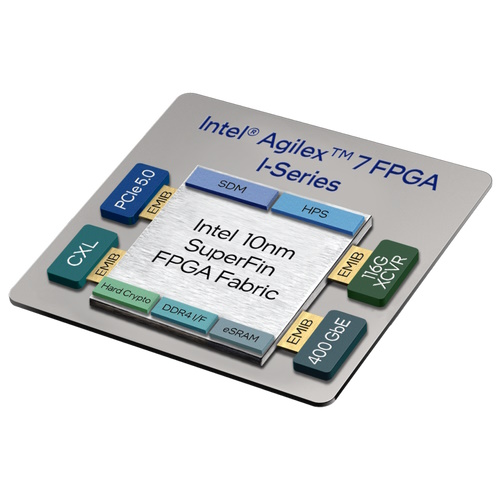
For example, I’m thinking of the Agilex 7 family of FPGAs and SoC FPGAs, which Intel introduced to service the extreme capacity and performance requirements demanded by applications like the network core and data centers. The first members of the Agilex 7 family, the F-Series and I-Series, are built using Intel 10 nm SuperFin process technology. More recently, Intel introduced the Agilex 7 M-Series, which is built using Intel 7 process technology and which expands upon Agilex 7 F-Series and I-Series features by offering in-package high-bandwidth memory (HBM), interfaces for external DDR5 SDRAM, and a hard Network-on-Chip (NoC) to maximize memory bandwidth.
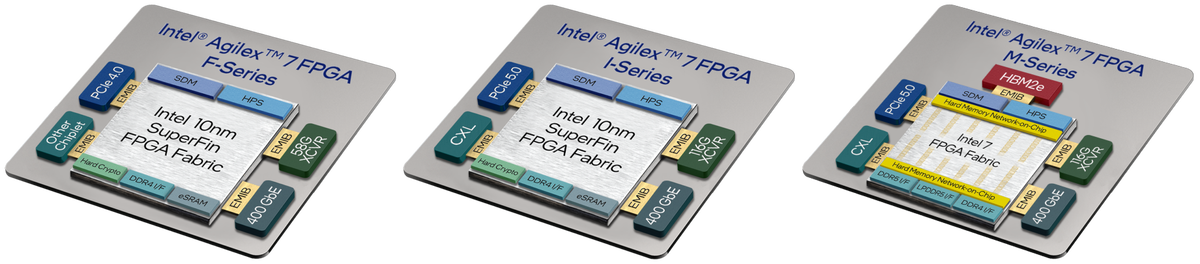
Intel Agilex 7 FPGA and SoC FPGA family members (Source: Intel)
In this context, the difference between FPGAs and SoC FPGAs is that the latter include an Arm Cortex-A53-based 32-bit quad-core hard processor system (HPS) (both types can support multiple soft-core processors implemented in the programmable fabric).
One aspect of these devices that’s really interesting is their use of chiplets, also known as tiles, which are small integrated circuit dice containing a well-defined subset of hardened functionality. In addition to the main FPGA die, Intel Agilex 7 devices can contain between one and six hardened transceiver (XCVR) tiles. These tiles—and the HMB2E stacks in the case of M-Series devices—are connected to the main FPGA die using Intel embedded multi-die interconnect bridge (EMIB) technology. EMIB is an elegant and cost-effective approach to the in-package high density interconnect of heterogeneous chips. The result is that all of these chiplets function as if they are a single large die.
To complement their extreme processing capability, Intel Agilex 7 devices support multiple types of XCVR tiles, including E-Tiles, F-Tiles, P-Tiles, and R-Tiles. Different members of the Intel Agilex FPGA family provide different numbers and combinations of these tiles. Facilitated by Intel’s EMIB and chiplet technology system, integrators have the possibility to devise a broad variety of XCVR capabilities utilizing different tile combinations. This allows customers to employ hardened transceivers while keeping the full capacity and flexibility of the FPGA soft logic. F-Tiles can support up to 400 Gbps Ethernet, while R Tiles can support PCIe 5.0 and CXL interfaces.
The reason for my waffling (yes, this is where I bring everything together) is that a bunch of my chums from Intel attended this year’s MWC just a couple of weeks ago as I pen these words. I can’t tell you everything that Intel showed at the show, if you see what I mean, but the Intel Programmable Solutions Group (PSG) did post this summary highlighting their portion of the proceedings. Of particular interest for me was a whitepaper and two solutions briefs as follows:
- Build Efficient and Cost-Effective mMIMO Solutions with Intel Agilex 7 FPGAs: With respect to radio towers transmitting and receiving wireless signals, this little scamp provides an easy-to-understand introduction to the difference between omnidirectional transmission, MIMO beamforming, and today’s next-generation massive MIMO (mMIMO) technology.
- Intel’s Accelerated Virtual Cell Site Router Solution on an Intel FPGA-Based SmartNIC N6000-PL Platform Helps Communication Service Providers (CoSPs) Increase Monetization of Their Services: Having read this little rascal, I now know the difference between a 4G radio access network (RAN) and a 5G RAN. I’ve also learned what a cell site router (CSR) is and what it does. I’ve also discovered that, as opposed to deploying a CSR as a dedicated box, it’s better to implement it as a virtual CSR (vCSR); also, that Intel has an accelerated vCSR solution in the form of a single Intel Agilex 7 FPGA-based SmartNIC—the Intel FPGA SmartNIC N6000-PL Platform—which can be plugged into an X86 server acting as a virtual distributed unit (vDU).
- Implementing Advanced Networking Solutions with F-Tiles in Intel Agilex 7 FPGAs: “Good Golly Miss Molly,” is all I can say after reading this little ragamuffin. Do you remember the XCVR chiplets we were discussing earlier in the form of E-Tiles, F-Tiles, P-Tiles, and R-Tiles? Well, this paper focuses on F-Tiles deployed in Agilex 7 FPGAs. In particular, it discusses F-Tiles for radio applications (e.g., JESD204 and Ethernet), F-Tiles for fronthaul applications (e.g., gateways, vCSRs), and F-Tiles for passive optical network (PON) applications (I now know what the acronyms OLT, ODN, and ONU stand for, and I have a much better appreciation for the “burstiness” of data as it appears at the OLT).
The more I think about it, the more I realize how lucky I’ve been in so many ways. When I wore a younger man’s clothes, for example, I attended live performances by some of the great artists of the time, like The Police, Supertramp, The Rolling Stones, 10cc, Elton John, Genesis, Led Zeppelin, and Crosby, Stills, and Nash, to name but a few. One act I regret not seeing live was Queen, but I just took a couple of minutes to watch this video of Barcelona, which is the title song of the collaborative album by Freddie Mercury and soprano Montserrat Caballé.
Now I want to visit Barcelona more than ever. I also want to attend MWC 2024. All I need is to find some company that wants to pay me to go. While I’m waiting for the offers to flood in, I’ll start cogitating and ruminating over the Hawaiian shirt wardrobe I’ll need for the trip. In the meantime, as always, I’ll be interested to hear your thoughts pertaining to anything you’ve read here (including tips for the best restaurants to visit and the “must-see” sights to see in Barcelona).


Leave a Reply
You must be logged in to post a comment.