I hail from a time when we could do naught but dream of computer memories with the capacity and performance of today’s offerings. On the bright side, I didn’t have to fight my way through using technologies like mercury delay lines. On the other hand, it wasn’t uncommon for the mainframe computers with which I came into contact to have a magnetic core store for main memory coupled with magnetic tape for long term storage.
I remember my first job after graduating university. I was a member of a team designing central processing units (CPUs) for mainframe computers at International Computers Limited (ICL) in West Gorton, Manchester, UK. When I wanted to access a file that I was working on a few hours or days before, I’d enter the appropriate request into the command line interface (CLI). The response was typically along the lines of, “Wait for a while… take a chill pill… we’ll get back to you when we feel like it.”
Eventually I discovered what was going on behind the scenes (“Pay no attention to that man behind the curtain”). My request would appear on an operator’s console in the main computer room. My username and the file name I’d given would be used to determine on which magnetic tape my file had been stored. Then a junior operator would be dispatched to retrieve that tape from the storeroom and load it on the first tape deck to become free. Fortunately, the pace of life was slower back then. I can only imagine what users would think if we did things this way today.
As an aside, since we are talking about technologies of yesteryear, my chum Jay Dowling just sent me a link to a video titled, How Photographs were Transmitted by Wire in the 1930s.
These days, for younger people who are constantly snapping pictures and videos with their smartphones and transmitting them around the world in seconds, it’s hard for them to wrap their brains around just how much things have changed. I know younger people might say something like “Of course things have changed, the mid-1930s were almost 100 years ago,” to which I would reply, “The mid-1930s were only 20 years before I was born!”
As another aside, in the middle of the 1990s, which was decades after computer memory technologies like static RAM (SRAM) and dynamic RAM (DRAM) in the form of semiconductor chips had grown to be ubiquitous, I visited a local government installation where they performed tests on missiles. You can only imagine my surprise to discover that the main memory in the primary missile test and data logging computer they were using daily was magnetic core store.
One of the things that never fails to amaze me is how technologies tend to have originated long before most of us think they did. Take semiconductor SRAM, for example. It’s common knowledge that Intel’s first SRAM (actually, it was Intel’s first product) was the 3101, which was introduced in 1969. This little scamp could store… wait for it… wait for it… 64 bits (due to a bug, only 63 bits were usable in the first version). Having said this, the concept of semiconductor IC memories was patented in 1963, and there were several other contenders before Intel.
What about DRAM? Once again, most engineers who have an interest in this sort of thing are familiar with Intel’s 1103 chip, which boasted 1,024 bits with a 1-bit bus. The 1103 was introduced in 1970, but the underlying concept was much older. As we read on the Wikipedia: “The cryptanalytic machine code-named Aquarius used at Bletchley Park during World War II incorporated a hard-wired dynamic memory. Paper tape was read and the characters on it were remembered in a dynamic store. … The store used a large bank of capacitors, which were either charged or not, a charged capacitor representing cross (1) and an uncharged capacitor dot (0). Since the charge gradually leaked away, a periodic pulse was applied to top up those still charged (hence the term ‘dynamic’).”
SRAM is very, very fast, but it requires six transistors per bit/cell, which requires a lot of silicon real estate (relatively speaking), it consumes a lot of power (relatively speaking), and it has low capacity (again, relatively speaking). By comparison, DRAM requires only 1 transistor and 1 capacitor per bit/cell, which needs to be periodically refreshed. DRAM has much higher capacity and much lower power consumption than SRAM. Also, its speed, while slower, is in the same ballpark as SRAM. The problem with both SRAM and DRAM is their volatility. When power is removed from the system, any information they contain “evaporates” away, as it were.
Flash memory has the advantage of non-volatility (it remembers its contents when power is removed from the system), but it wears out over time because repeated erasing and writing cycles cause its cells to degrade and eventually stop working (sad face). This should in no way detract from the fact that we use copious amounts of NAND Flash for bulk storage applications, while NOR flash shines when it comes to code storage and execution tasks (see also NOR Flash is Sexy Again! and What? NOR Flash Just Got Even Sexier?).
The Holy Grail of the semiconductor memory industry is to create a device with the speed of SRAM, the capacity of DRAM, and the non-volatility of Flash, all while boasting longevity and low power consumption when running (the power consumption would, of course, be zero when the system is powered-down).
There are several lesser-known memory technologies that enjoy niche markets, including Ferroelectric RAM (FeRAM, FRAM), Resistive RAM (RRAM, ReRAM, Memristors), Phase Change Memory (PCM), and Magnetic RAM (MRAM). As Steve Leibson wrote in his 2022 column Can Any Emerging Memory Technology Topple DRAM and NAND Flash? “MRAM competes for sockets with the usual suspects: flash memory, battery-backed SRAM, occasionally FRAM, sometimes battery-backed DRAM. Designers are looking for nonvolatile memory that gives them a balance among capacity, price, performance, and convenience. For most of us, that’s flash memory. But flash is slow, it wears out, and it requires fiddly handling. If you want speed, you go with SRAM and deal with the size and cost of the batteries. If you’re a hardcore datacenter manager, you might use battery-backed DRAM, along with much bigger batteries. Or, if you’re adventurous, you might go with FRAM. What MRAM offers that the others don’t is the speed of DRAM or SRAM (it depends), but in a nonvolatile flavor. Unlike flash memory, it’s randomly addressable and doesn’t ever need to be erased. No BIOS changes or software layers. The downside is that MRAMs are more expensive per bit than other nonvolatile memories, and they’re not very big. While DRAM makers are shipping boatloads of their 32-Gbit DDR4 devices, Everspin’s largest device is a 1-Gbit MRAM. And, they’re kinda pricey compared to DRAM or flash. But MRAM’s advantages can outweigh those shortcomings, for the right kind of customer. Everspin makes chips that are pin-compatible drop-in replacements for SRAMs but that don’t require batteries or supercapacitors. That saves a lot of space, eliminates the power switchover logic, and gets rid of the scary chemical bomb that batteries can become. Batteries and big caps don’t shrink over time, either, so the space you dedicate to them today will still be with you tomorrow and the day after that.”
Speaking of Everspin (we weren’t but we are now), I was just chatting with some of their brainy boffins who brought me up to speed (no pun intended) with the latest and greatest developments associated with their super-fast MRAM technology.
First, we have their PERSYST persistent data memory solutions in the form of Toggle MRAM, Industrial Spin-Transfer Torque (STT) MRAM, and Data Center STT MRAM, all of which have write latency and endurance (write cycle) values in the SRAM and DRAM ballpark. Members of the PERSYST family are already deployed in the field.
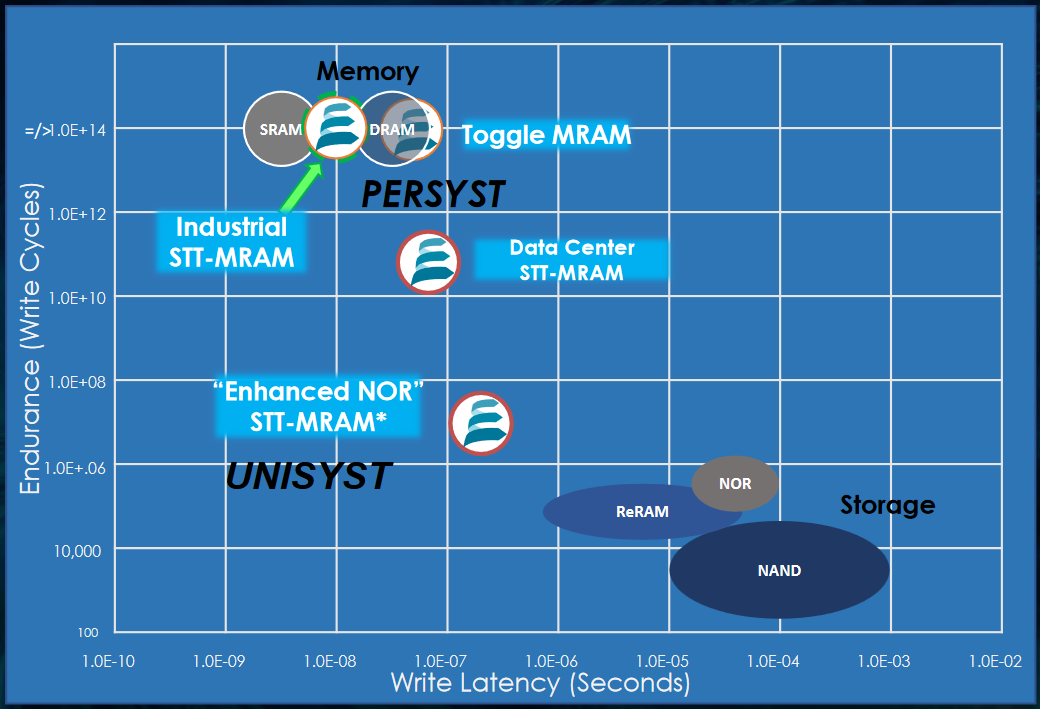
PERSYST and UNISYST for varying memory workloads (Source: Everspin)
Next, we have UNISYST Enhanced NOR SST MRAM, which is targeted at unified code and data memory applications. UNISYST is currently in design.
Also, not shown in the above diagram, we have AgILYST for “innovation and transformation” in the form of configuration bits for FPGAs and Data MRAM for artificial intelligence (AI) neural networks (NNs).
On the one hand, MRAM isn’t the Holy Grail of memories because it lacks the raw capacity of DRAM. On the other hand, although some may see MRAM as a niche market, it’s a niche market that’s growing in leaps and bounds, and Everspin is well placed to take full advantage of the ever-increasing requirements for state-of-the-art MRAM solutions.
What say you? What do you think about non-traditional memory technologies like FeRAM, ReRAM, PCM, and MRAM? And how long do you think it will be before we do discover the Holy Grail of memory?


Leave a Reply
You must be logged in to post a comment.