
A recent video appearing on Laurence Brown’s “Lost in the Pond” YouTube channel discusses six English words brought to America in the 1600s, during its colony days. Many of these words can be traced to the plays of William Shakespeare and were therefore used in England during the late 1500s and early 1600s. Although the use of these words died out in England four centuries ago, they are still somewhat common in the United States. The six words from Brown’s video are:
Yonder – means “over there” as in “He lives over yonder” or “there” as in “Off we go, into the wild blue yonder.”
Catty-cornered (in the US Southeast) or Kitty-cornered (in the Northern and Western US) – means diagonally across, as in “the house kitty-corner from ours.” This word evolved from the archaic English word “cater,” which means to cut something or to move something diagonally.
Fall – as in autumn. Refers to the period during the year when leaves fall off the trees.
Homely – which now means “comfortable in someone’s home” or “homey” in England, but it means “not very good looking” in the US.
Flapjack – which refers to a pancake in the US. This word fell out of use In the UK, but it reappeared in the 1930s as the name of a snack made of oats and resembling a granola bar.
Skim milk – which is called “skimmed milk” in the UK, possibly because we’re just lazy in the US.
These usage differences are often called language drift. I’ve heard that the dialect of Spanish used in Mexico is similarly archaic compared to the Spanish language used in modern Spain. I’ve also been told by a native Central American Spanish speaker that my version of Spanish, learned six decades ago in Kentucky’s public school system, sounds like I have an Italian accent. Go figure.
Brown’s amusing video reminded me that many terms in electronics have similarly fallen out of favor over the last few decades. I’m old enough to remember or at least have seen the following terms, written down in no particular order.
Nybble – referred to a 4-bit word and was a knock-off of “byte,” but I never see this term used any more. AMD’s 2900 family of 4-bit slice chips were also referred to as “nybble slices.”
Condenser – is the old name for a capacitor. An even older term for a condenser is “accumulator.”
Coil – more commonly called an inductor today.
Choke – another term for inductor. It refers to “choking off the current” at high frequencies.
Rheostat – a 2- or 3-terminal variable resistor, more commonly called a potentiometer or “pot” today. Technically, a potentiometer is always a 3-terminal device but rheostat and potentiometer have been used as synonyms for decades.
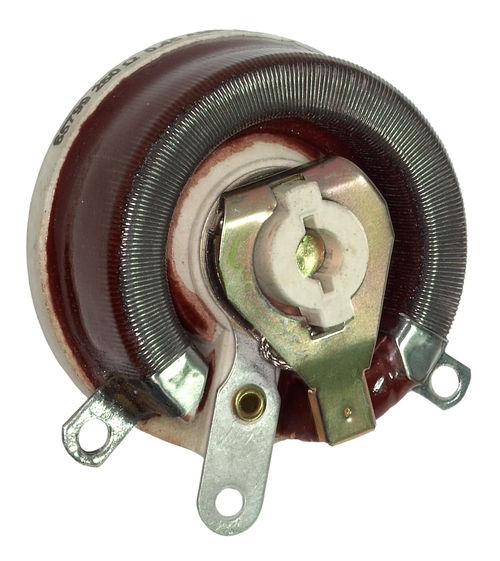
Power rheostat. Image credit: Ohmite
Dry cell – referred to a sealed battery cell that used a paste electrolyte. Generally, we just say “battery” today, as in “AA batteries,” even though a “battery” is supposed to be a composite device made of dry or wet cells. No one says “I’m going to Harbor Freight” to pick up a package of AA dry cells.”
Octal – means base 8 today but, in decades past, this term referred to an 8-pin tube socket. Octal (base-8) numeric notation was far more common during the 1980s and was used by many minicomputer systems makers such as Digital Equipment Corporation (DEC) and Hewlett-Packard (HP). Octal notation was especially useful for DEC’s 18-bit minicomputer architectures (evenly divisible by 3), but these days, you’re much more likely to see hexadecimal (hex, or 4-bit) notation, which is far better for today’s 8-, 16-, 32-, 64-, and 128-bit computer architectures.
Micro-micro-Farad – currently called picofarad (pF) or “puff” in the SI system.
Milli-micro-Farad – I don’t recall using the SI system’s Nanofarads (nF) in the 1960s, 1970s, or 1980s. I don’t think this unit of capacitance was used in the US until more recently. Anyone for milli-micro-Farad?
MilliFarad – gone and forgotten.
MFD or mfd – an older and more confusing way to print microfarad (µF) on a capacitor, before fancier printing methods that could handle Greek letters became available.
Megacycles per second (Mc) – currently called Megahertz (MHz) in the SI system. You would frequently see radio dials of the 1940s and 1950s marked with the Mc and Kc (see Kilocycles) nomenclature.
Kilocycles per second (Kc) – currently called Kilohertz (KHz) in the SI system.
Multivibrator – is the old name for a cross-coupled amplifier pair made from two vacuum tubes or two transistors. There were astable multivibrators (oscillators), monostable multivibrators (one-shots), and bistable multivibrators (flip-flops). These days, “flip-flop” seems to have been shortened to “flop,” as in “there are a couple of billion flops on that IC.”
Single-shot – is an older term for a one-shot multivibrator.
Thyristor – is a 4-layer semiconductor switching device, usually used to handle high-power current switching. General Electric used the trade name “silicon-controlled rectifier” instead of thyristor, and the abbreviation “SCR” came to dominate in general usage. These days, “bidirectional thyristors” are called triacs, commonly found in light dimmers and other ac power-control circuits.
Bar – was the term Texas Instruments and some other early semiconductor makers used instead of “semiconductor die” or “chip.”
Dih (or Dit) and Dah – is an older term for Morse code’s dots and dashes, not to be confused with “Doo-Dah,” which is the song that the Camptown ladies sing in Stephen Foster’s “Camptown Races.”
Rectifier – is an older term for diode. I remember large, finned selenium rectifiers used in tube radios. These were never called selenium diodes, as far as I can remember. The selenium rectifier was invented in 1933, and it was the first solid-state rectifier to be sold on the market. As soon as silicon power diodes appeared, selenium rectifiers disappeared. You could always tell when a selenium rectifier had failed, because of its unique odor, which could be sickly sweet at first and then would transform into the smell of rotten fish when the failure became catastrophic.
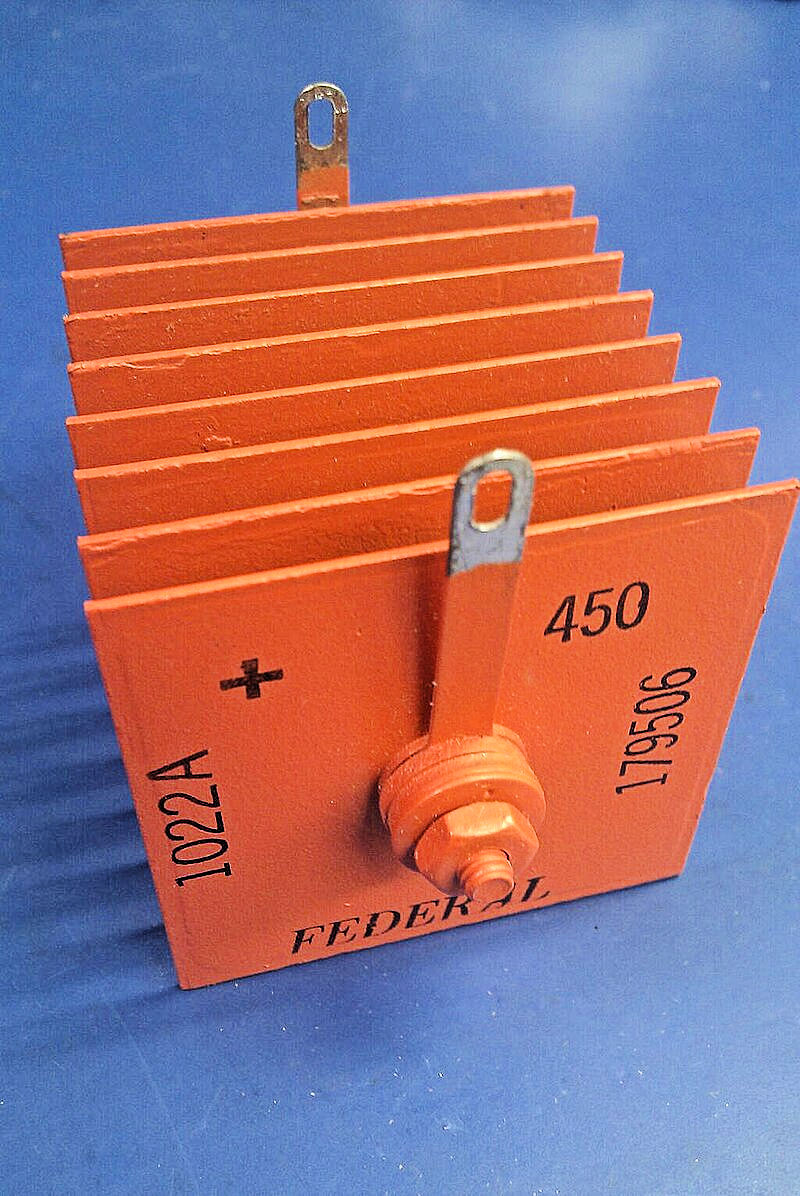
Federal brand selenium rectifier. Image credit: Binarysequence, Wikipedia
Return – is an old name for ground.
RTL – once meant “resistor-transistor logic,” back in the 1960s. As of the 1980s, it now stands for “register transfer level” and appears in discussions of hardware description languages (HDLs).
Solid State Lamp (SSL) – an archaic term for LED.
Vacuum tube Voltmeter (VTVM) – was an electronic version of a volt-ohm-meter (VOM, now called a multimeter), which used vacuum tubes to amplify signals and provided the readout on a moving-coil meter. In the 1960s, VTVMs evolved into FET VOMs, which replaced the vacuum tubes with FETs but kept the moving-coil meter. I won a VTVM in a high school science fair and built a couple of Heathkit FET VOMs (the IM-25 and IM-17) during the late 1960s. Today, we use digital multimeters (DMMs), which dispense with the expensive and fragile moving-coil meter in favor of more rugged digital displays driven by A/D converters. I’ve got older DMMs from Fluke and Keithley and a box full of “free” DMMs from Harbor Freight. Today’s DMMs are equally likely to come from a long list of creatively named vendors who did not exist a few decades ago.
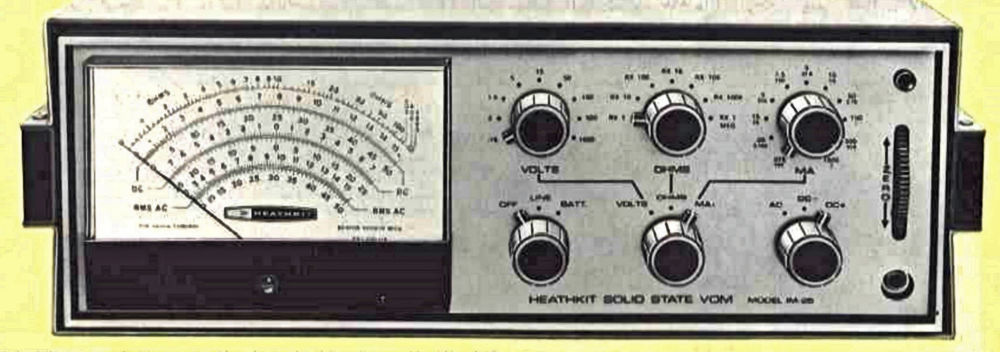
Heathkit IM-25 FET VOM, circa 1969. Image credit: Heathkit
I’m certain that this is not an exhaustive list of old electronics terms. Perhaps you know more archaic electronics terms. If so, please leave them in the comments below.


Leave a Reply
You must be logged in to post a comment.