My recent article about language drift in electronics over the past half century or so (see “Old Electronics Terms Show Language Drift Over the Decades”) seems to have generated a lot of interest, so let’s take another time-traveling walk through the same time period, and let’s focus on how young people might get interested in electronics. I’m going to use my own experience and compare it with today’s opportunities. Some things have changed; some things have stayed the same; and some have died out and have either reappeared or are in the process of reappearing.
When I was born in the early 1950s, plastic model kits were just becoming popular. These kits are one of the first stepping stones for young people to use when learning about the component parts of real engineered artifacts and for learning how to follow complex, detailed directions. My preference was for automobile model kits, particularly from AMT and Monogram, but I built ships and airplanes from Revell, Renwal, and Lindburgh as well. (I lusted for the Renwal Atomic Cannon kit but could never afford it.) While building these model kits, I learned about engine parts (alternators, fan belts, distributors, valve covers, intake and exhaust manifolds, and exhaust headers), chassis components (springs, shocks, differentials, A-arms, and steering components), and interior parts (steering wheels, instrument clusters, shifters, and seat belts). There’s a fundamental element to all engineering that requires you to learn about component parts, whether it’s for automotive engineering or electronics. This knowledge has stayed with me.
The plastic model kit manufacturers ran into serious trouble starting in the 1980s as video games became the dominant recreational activity for young people. Soon, the big-name model kit companies were being passed around from owner to owner like a contagious virus. Today, a company called Round2 LLC owns several familiar, old-line model kit brands including AMT, MPC, Hawk/Lindberg, and Polar Lights (a descendent of Aurora). Meanwhile, Monogram merged with Revell. That company was purchased by Hobbico – which went bankrupt in 2018 and is now owned by Quantum Capital Partners. Consequently, you can still buy plastic model kits from these 1960s brands in many stores and online, but they cost a lot more money these days.
I quickly graduated to model rockets, particularly kits from Estes Industries in Penrose, Colorado. Model rocketry taught you even more about engineering. You learned to make your own component parts such as rocket fins, and you learned that there were right and wrong ways to make these parts. For example, the grain of the balsa wood needed to be aligned with the leading edge of a rocket fin or else the fin would be weak and could break quite easily. You learned that if you did not use the right flame-proof wadding to protect the parachute, the rocket engine’s ejection gases would melt the parachute and your rocket would fall to earth and break. (Ask me how I know.) You also learned some real engineering terminology such as center of mass, center of pressure, and specific impulse.
Estes was founded by Vern Estes, who invented a machine that automated the manufacture of model rocket engines. He worked tirelessly to make model rocketry into a credible hobby and to get the U.S. Post Office to allow rocket engines to be shipped in the mail. Estes Industries was founded in 1958, just in time for me to catch the model rocketry bug. Vern and his wife Gleda eventually sold the company to Damon Corp, and the company then was passed around and eventually was sold to Estes Industries LLC in 2018. So, you can still get Estes rockets from multiple sources.
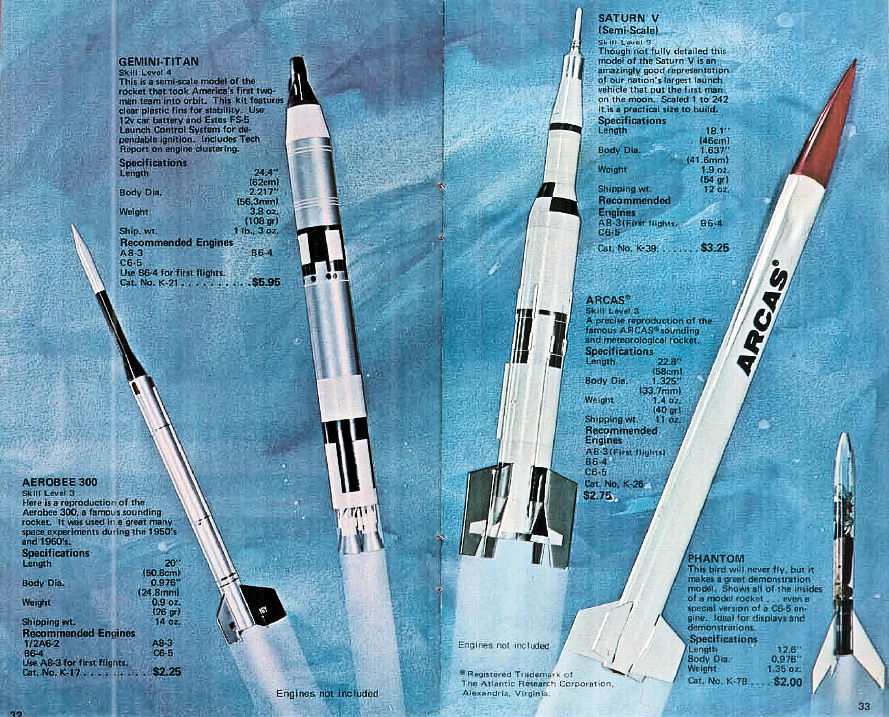
Estes rockets circa 1973. Image credit: Estes Industries
In the mid-1960s, electronics started getting popular, given a boost by military and aerospace projects. I became interested in electronics in the late 1960s and started buying electronic kits from Radio Shack, Heathkit, and Eico. Radio Shack sold a line of simple, inexpensive electronic kits in plastic packaging that doubled as the project box. These were “P-box” or “project box” kits.
Radio Shack started in 1921 as one store that was devoted to radio hobbyists through its storefront and through mail order. Tandy Corporation, a leather company, bought Radio Shack in 1962, and, over the decades, the company grew into an 8000-store behemoth. These Radio Shack stores were part consumer electronics store, part electronics hobbyist store, part personal computer store, and part CB radio store. Radio Shack had a mature catalog business, but the company completely missed the Internet e-commerce revolution. Companies like Amazon and eBay ate Radio Shack’s lunch, and the company declared bankruptcy in 2015. Nearly all the U.S. Radio Shack stores closed, with the exception of a few franchise stores, and the real estate was sold off. (See “The Radio Shack at the End of the Universe.”) So those 8000 stores aren’t coming back. Today, there’s activity on the RadioShack (new spelling) Website, but it appears that the company is mostly interested in selling consumer electronics and related consumer gear once it gets reorganized.
Heathkit started as an aircraft company in 1911, went bankrupt, and was resurrected as an electronics kit company after World War II when surplus electronic components from the war effort were cheap and plentiful. I built several Heathkits, including digital clocks, test equipment, and a microwave oven. I had to drive to Heathkit’s headquarters in Benton Harbor, Michigan to pick up the microwave oven. I was 17 and drove my mother’s 1967 Pontiac Catalina station wagon from Louisville, Kentucky to Michigan. It was my first long-distance drive. The microwave oven kit barely fit in the back of our station wagon. Along the way, as the number of completed kits grew, I became very familiar with the look of electronic components and learned to troubleshoot circuits from the schematic. Heathkit’s documentation was always world class.
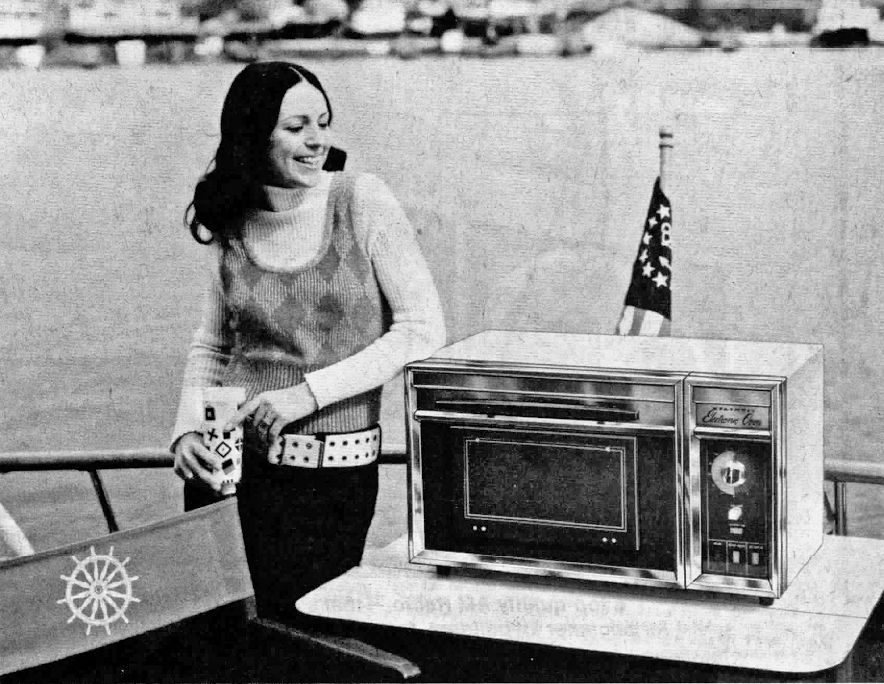
The Heathkit Microwave Oven placed precariously near the railing on a boat. Image credit: Heathkit
Heath discontinued its electronic kit business in 1992 and focused on its educational business. After passing through the hands of several owners who knew next to nothing about Heathkit’s businesses, the company went bankrupt in 2012. A year later, the company’s Website was revived, the company was reorganized, and today, you can purchase three Heathkits: a digital clock, an AM radio receiver, and a microprocessor trainer. You can also purchase upgrades and components for some of the company’s original kits from the past. It’s a far cry from the glory that was once Heathkit, but at least they’re not gone.
That history brings us to today. What are today’s choices for introducing young people to the world of electronics? Actually, I think we have more choices today than we did back in my early days. As I’ve mentioned, kids can still get started with plastic model kits and model rockets. Those once and future model kit companies have hung on in some form or another. Heathkit is still with us, but if you want to build electronic kits, you’ll have an easier time finding low-cost kits made in China that are being sold on Amazon and eBay. Want to build a digital clock? No problem. Want to build a frequency counter or a component tester? Also, not a problem.
You’ll find a variety of kits that you can order online from companies such as Amazon, DigiKey, Jameco, Sparkfun, and American Science and Surplus, among others. You can also get individual electronic components from these vendors, delivered in a day or two. It’s not as convenient as Radio Shack, but the variety and prices are far better. These kits are shockingly inexpensive, but they have one drawback relative to Heathkits. The instructions and documentation barely exist. These kits are not great for learning electronics theory.
Today’s most popular electronic kits for “makers” (today’s au courant term for “hobbyists”) are single-board computers (SBCs) such as the Arduino, one of the several Raspberry PI boards, or the BeagleBone. The electronics hobby sphere is filled with these kits. For education, you can rely on large online communities that support these SBCs with tutorials, projects, and accessories. The vibrant world of hobby SBCs is far larger than the kit-building world of the 1960s, 1970s, and 1980s.
That’s the state of the art in the electronics hobby today. How about you? Did you build model kits? Model rockets? What were your experiences with electronics while growing up? Please leave your comments below.


Leave a Reply
You must be logged in to post a comment.