

Thirty Terabytes. These two words don’t ordinarily go together to describe the capacity of a hard drive, but Seagate has just introduced a 3½-inch hard drive family – called the Exos Mozaic 3+ – with a maximum capacity of 30 Tbytes. These drives store more than 3 Tbytes per platter. Contrast this 30Tbyte drive with my first hard drive, a Seagate ST-225, which I bought in 1985 for a home-built IBM PC clone. The ST-225 was a half-height, 5¼-inch, 20Mbyte hard drive with an MFM interface. It required an external hard-drive controller board. At 30Tbytes, the largest Exos Mozaic 3+ drive has more than six orders of magnitude more storage capacity than my original ST-225, bought nearly 40 years ago, as shown in the figure below. That’s a huge capacity increase and an achievement that easily rivals Moore’s Law scaling in semiconductors.
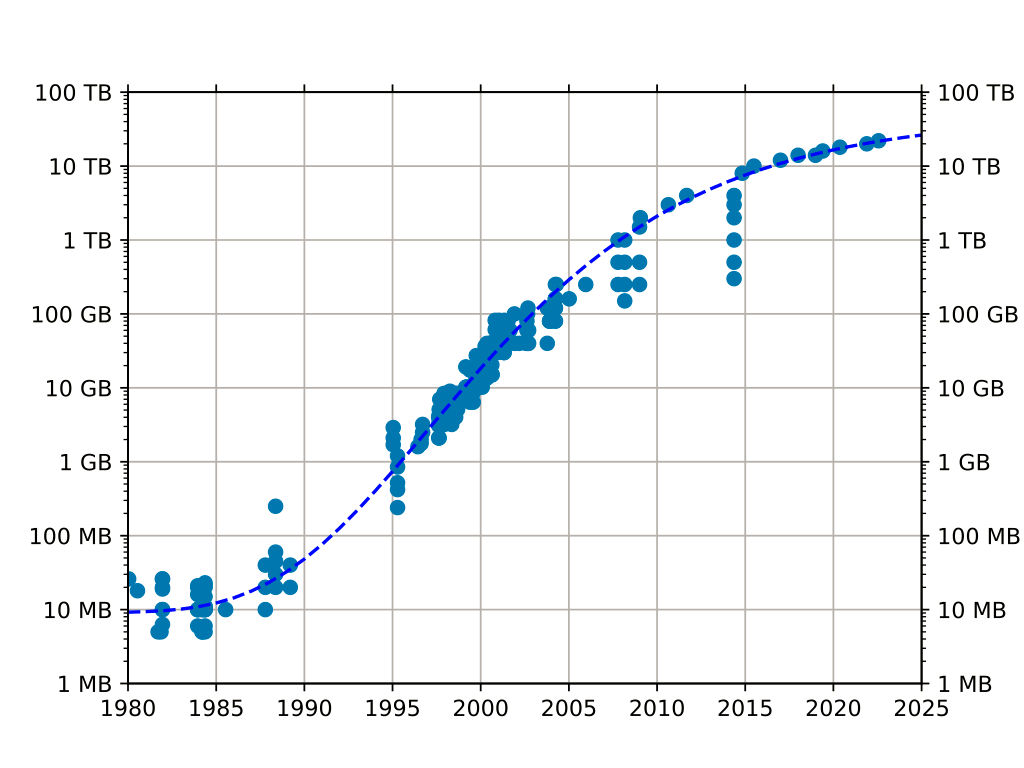
Hard disk drive capacity has increased by more than six orders of magnitude since 1980. Image credit: Eheran, Wikimedia Commons
Seagate needed to rethink nearly everything in these drives to achieve this capacity. The Exos Mozaic 3+ hard drives use HAMR (Heat Assisted Magnetic Recording) instead of PMR (Perpendicular Magnetic Recording) to store bits. A small laser on the drive’s recording head heats a spot on the recording media to lower its magnetic coercivity before the magnetic recording head writes the bit onto the media. The heated spot cools in a nanosecond as it spins away from the recording head. PMR itself is less than 20 years old in commercial products. Although the technology was first discussed as far back as 1976, Toshiba introduced the first PMR hard drive, a 1.8-inch model, in 2005, and Seagate introduced its first PMR hard drive – the 2.5-inch, 160Gbyte Momentus 5400.3 SATA hard drive – in 2006, when Seagate also announced that its future hard drives would use PMR, which they have. Until now.
Prior to 2005, hard drives used LMR (Longitudinal Magnetic Recording), which is the magnetic technology developed by IBM for the original RAMAC (Random Access Method of Accounting and Control) 305 computer system, introduced in 1956. The RAMAC system incorporated the world’s first hard drive, called the IBM 350 disk storage unit, which was purpose built for the RAMAC 305 computer. (In the 1950s and 1960s, peripherals such as line printers and magnetic storage devices were purpose built for the target computer system.) The RAMAC disk storage system was 6 feet tall, 5 feet wide, and 3 feet deep. It weighed one ton and stored 5 million characters on its vertical stack of fifty 24-inch platters. Back then, IBM used 7-bit EBCDIC characters, so the actual storage capacity as we measure things today was about 3.75 Mbytes. (The collection at the Computer History Museum (CHM) in Mountain View, California now includes a restored and operational IBM 350 disk storage unit. You’ll find a 3-hour CHM oral history video covering the IBM 350’s development here.)
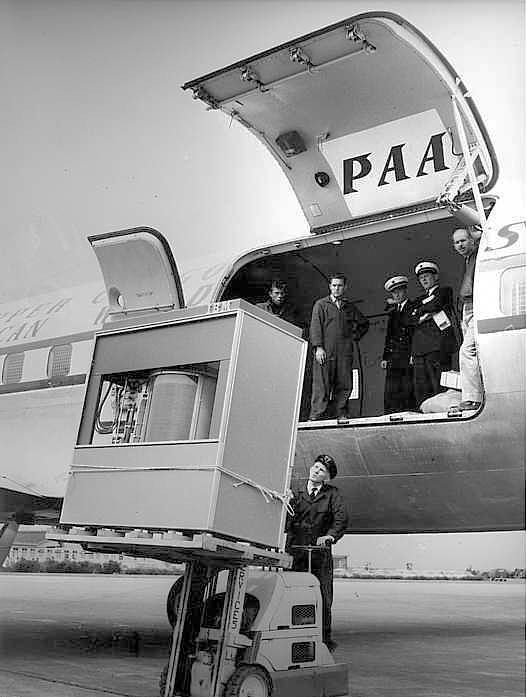
IBM 350 RAMAC disk storage system being unloaded from a Pan Am cargo plane. Image credit: IBM
IBM’s search to find a magnetic storage technology that would be faster than tape began in 1952, in a rented building at 99 Notre Dame Ave, located in downtown San Jose, California. Back then, this building overlooked a plum orchard. Now it overlooks the elevated Highway 87 that cuts through the center of San Jose’s downtown area. The IEEE and ASME have placed bronze plaques at this location to commemorate the RAMAC disk drive’s development. In 1958, IBM commissioned a short film named “The Search at San Jose” that documented the company’s development of the first hard disk drive. It’s on YouTube. Some 70 years later, you may find the 12-minute IBM film informative, delightfully quaint, and somewhat sexist. It was a product of its time.
If you watch the IBM film, you’ll hear that the company coated the IBM 350’s disks with “magnetic paint.” That was an iron oxide emulsion – basically rust – which led to a euphemism for hard drive storage: “spinning rust.” In the IBM film, you’ll see that IBM eventually developed spin coating for the iron oxide emulsion to avoid creating pinholes in the magnetic coating. The film shows a technician pouring the magnetic emulsion onto a spinning disk platter using a paper cup. A somewhat more sophisticated form of spin coating later became essential to the semiconductor industry as well.
The RAMAC 350 disk storage unit was so successful that IBM built the 190-acre Cottle Road campus in south San Jose. The plant opened in 1957, one year after IBM announced its first disk drive. The Cottle Road plant became the center of IBM’s hard disk development, and it appears in “The Search at San Jose” film. The plant’s campus consisted of five interconnected steel, concrete, and glass structures that were faced with brick and multi-colored tiles that were reminiscent of an IBM punch card. That’s ironic, because hard disks helped to obsolete punched cards as a storage medium.
Architect John Savage Bolles collaborated with landscape architect Douglas Baylis to incorporate gardens, patios, and reflecting ponds into the plant’s overall design. The reflecting ponds doubled as containers for the plant’s industrial water storage. IBM commissioned modern art for the campus including sculptures from Bay Area artists Bob Howard and Gurdon Woods. The Cottle Road campus captured and reflected the energy and optimism of post-war America, and it was considered a shining example of modern industrial architecture.
IBM remained a leader in hard disk design and manufacture until it sold the business to Hitachi in 2003. Hitachi renamed the IBM disk drive group. It became Hitachi Global Storage Technologies (HGST), which continued to make drives in the 3¼-inch Deskstar and 2.5-inch Travelstar hard disk product lines originated by IBM. Hitachi sold HGST to Western Digital (WD) in 2012, which promptly ended development of the Travelstar hard drives and then wound down the Deskstar products starting in 2018. As those storage products faded out, so did IBM’s hard disk legacy. Sadly, the groundbreaking Cottle Road plant was demolished a few years later to make room for more housing.
We’ve long past graduated from the rust-based magnetic coatings used for early hard drive platters. Because of their high bit density, Seagate’s Exos Mozaic 3+ drives use an iron-platinum (FePt) film coating as the magnetic storage medium because previous magnetic coatings don’t exhibit the high magnetic coercivity needed to prevent adjacent, closely packed bits from flipping each other. Instead of spin coating, Seagate applies the FePt coating to the Exos Mozaic 3+ drive’s glass platters with epitaxial growth followed by thermal annealing to create a molecular superlattice with a more uniform magnetic grain distribution.
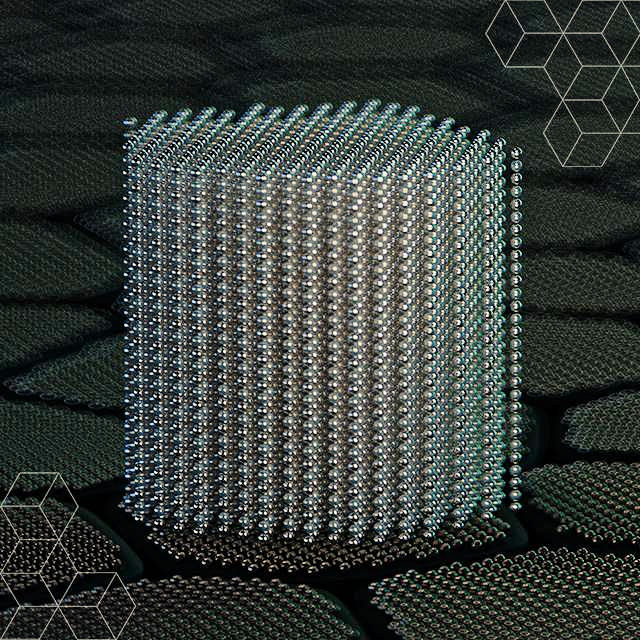
Seagate creates an iron-platinum (FePt) superlattice to form the magnetic storage grains on the glass platters of its 30Tbyte Exos hard drives. Image credit: Seagate
The resulting FePt magnetic platters cannot be written on by conventional PMR write heads. The high-coercivity material needs some extra oomph to flip the magnetic moment stored in each grain. A “nanophotonic” laser built into the Exos Mozaic 3+ write head provides the additional oomph through thermal energy. A photonic funnel channels the laser’s energy into a photonic antenna, which focuses the laser light onto a spot the size of the intended perpendicular magnetic bit. According to Seagate, the photonic antenna converts the laser light into plasmons, which are to an electron plasma what photons are to light. Accordingly, Seagate has named the new magneto/optical write head a “plasmonic writer.” (People in Seagate’s marketing department must have been working overtime to name this stuff.) The plasmonic writer heats the intended grain on the platter to 800° F, the magnetic head writes the bit, and the heated grain then cools in 2 nanoseconds.
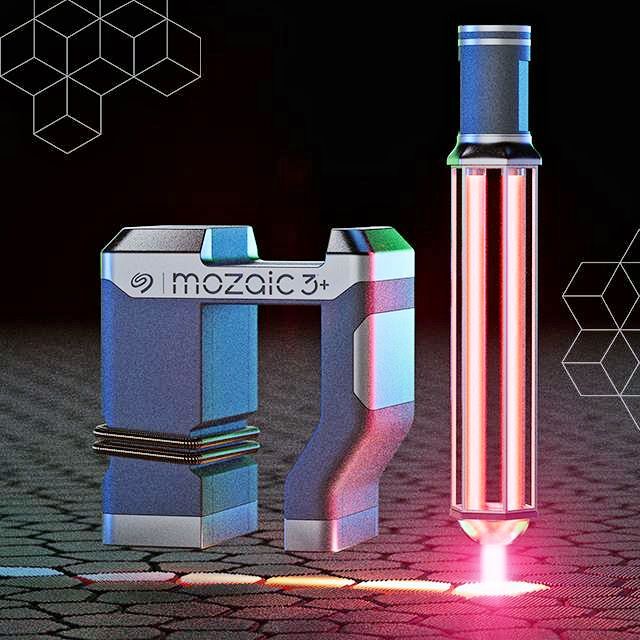
The plasmonic writer in the Seagate Exos 30Tbyte hard drive uses a laser to lower the coercivity of the disk platter’s FePt storage layer so that the PMR (Perpendicular Magnetic Recording) head can induce the right magnetic moment to the selected magnetic grain. Image credit: Seagate
Seagate developed a 7th-generation spintronic reader to sense the tiny magnetic bits in the Exos Mozaic 3+ drives. These readers are based on magnetic tunnel junctions and rely on a stack of magnetic and non-magnetic layers to sense magnetic fluctuations through a phenomenon called tunneling magnetoresistance. These spintronic readers are a far cry from the wound-wire magnetic heads in the original IBM 350.
To manage the plasmonic/spintronic read/write head’s positioning through servo control while processing the signals coming from the spintronic reader using a 4-gsamples/sec digital sampler, Seagate developed its own hard disk controller chip, manufactured with a 12nm process node.
Collectively, Seagate calls these new recording developments the Mozaic 3+ platform. Today, this platform stores more than 3 Tbytes per disk platter, so the 30Tbyte Exos Mozaic 3+ drive has 10 platters. The 3Tbytes/platter recording density represents a 25% improvement in areal bit density compared to Seagate’s best PMR hard drives. However, the company has a roadmap for increasing this density to more than 5 Tbytes/platter in the future, which would more than double areal density over what Seagate’s PMR drives can achieve today. If you’re doing your math, that means that LMR lasted for almost 50 years and PMR seems destined to fade away after only 20 years.
Currently, there appears to be no public data sheet for Seagate’s Exos Mozaic 3+ hard drives, but the information about these drives that appears on the Seagate site is listed under the Exos X drive category. Other Exos X drives have SATA interfaces that operate at 6Gbps and SAS interfaces that operate at 12Gbps. I would therefore expect to see the Exos Mozaic 3+ drives to have SATA and SAS interfaces that are at least as fast as other Exos X drives, and perhaps faster.


Leave a Reply
You must be logged in to post a comment.